
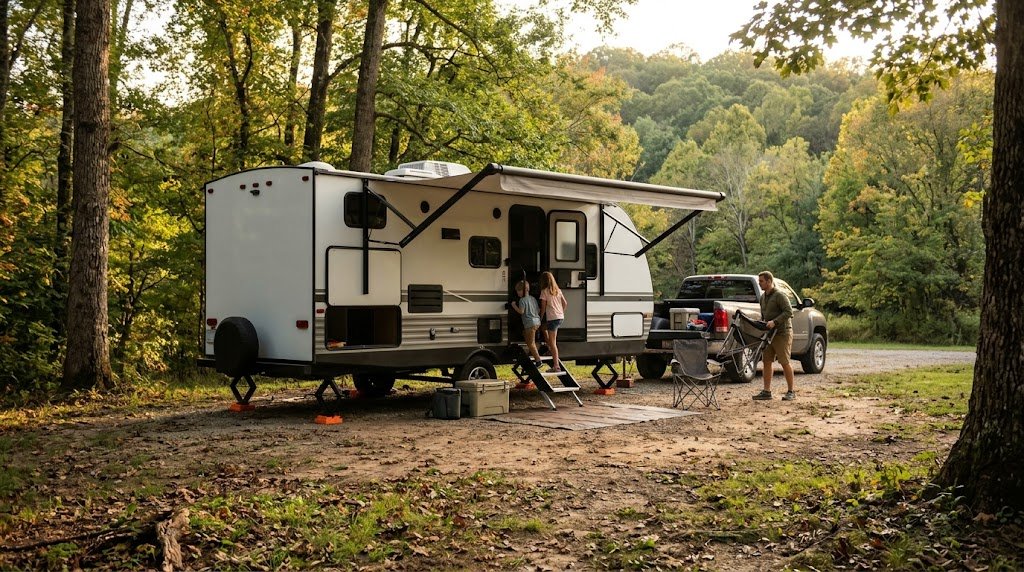
Best Bunkhouse Travel Trailers for Families: Floorplans and Sleeping Space
The best bunkhouse travel trailers for families give kids their own bunk area, give parents a separate bedroom, and offer enough real beds for everyone before any convertible sleepers are counted. Look for floorplans around 30 to 32 feet that sleep seven or more, like the Prime Time Tracer 250BH and 275BH or the Avenger 26DBS. Then confirm bunk size, dry weight, and your tow vehicle’s rating before you buy.
What Is a Bunkhouse Travel Trailer?
A bunkhouse travel trailer is a towable RV with a dedicated sleeping area for children, usually built-in bunk beds, separate from the main bedroom. The idea is simple. Kids get their own space, parents get a door to close, and the living area stays free for meals and downtime.
Most bunkhouse models are built around the same basics: a primary bedroom at the front, a kitchen and living area in the middle, and bunks at the rear. Some floorplans add a second entry door, a walk-in pantry, or an outdoor kitchen.
Bunkhouse trailers suit families with two or more children, grandparents who travel along, and anyone who regularly hosts friends at the campsite. If your family travels as a couple with one small child, a simpler floorplan can save weight and cost. If you are still deciding on overall size, our guide on the best travel trailer for a family of four covers the broader picture.
What Are the Most Common Bunkhouse Floorplans?
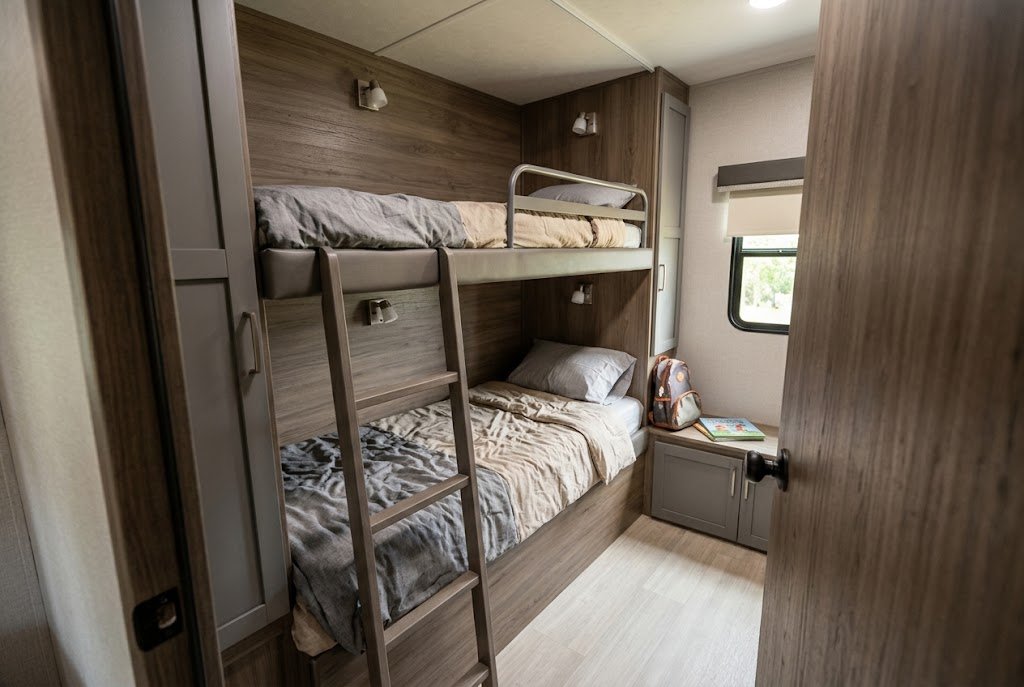
Most bunkhouse floorplans fall into three groups, based on where the bunks sit and how the bathroom is placed. Each layout changes how the trailer feels at night and in the morning.
Rear bunks with a rear bathroom: Bunks sit in one back corner and the bathroom in the other. The 2026 Prime Time Tracer 275BH uses this approach, according to the manufacturer’s floorplan description. It keeps nighttime bathroom trips away from the front bedroom.
Bunks with a rear full bath and a central living area: The 2021 Keystone Hideout 272BH is listed with a front bedroom, a center kitchen and living area, and a rear full bath.
Front bedroom with a king bed and a bunk room at the back: The 2027 Prime Time Avenger 26DBS lists a front king bedroom, a rear bathroom, and a bunkhouse.
When you compare floorplans, look at the floor plan drawing first. Photos can hide how narrow the aisle is or how close the bunks sit to the door.
How Many People Does a Bunkhouse Really Sleep?
The “sleeps” number counts every possible sleeping surface, including the dinette and sofa, so the number of fixed beds is usually lower. A trailer rated for eight does not mean eight people sleep comfortably in permanent beds.
Here is how to read the numbers:
Count the permanent beds: the primary bed and the bunks.
Add convertible spots, such as a dinette that folds into a bed or a jack-knife sofa.
Treat the convertible spots as guest or overflow space, not daily beds.
For example, the Hideout 272BH is listed as sleeping 10, but its spec sheet shows one queen bed and two bunk beds. Reaching ten depends on convertible furniture. That is useful for an occasional crowd and less comfortable as a nightly arrangement.
A good rule for families is to count your own people against the permanent beds, then use the extra capacity as a bonus. Ask the dealer for a bed-by-bed breakdown on any unit you are considering.
Which Bunkhouse Travel Trailers Fit Families Best?
The best fit depends on your family size, tow vehicle, and budget. Here are four units listed at Camp-A-Rama in Benton, KY, with specs taken from each listing. Inventory changes often, so confirm availability first.
Best for a lighter tongue: 2026 Prime Time Tracer 250BH. It measures about 30 feet, sleeps 7, and lists a dry weight of 6,068 pounds with a 650-pound hitch weight. That hitch weight is the lowest of the four, which can matter for a vehicle with limited tongue capacity. The listing also shows a rear bathroom, a 17-foot awning, and a tankless water heater.
Best for a bigger family: 2026 Prime Time Tracer 275BH. It sleeps 8, measures about 32 feet, and lists two entry doors, a front bedroom with a king bed, and a rear bathroom. The gray tank holds 102 gallons, which helps on longer stays without hookups. Dry weight is 6,338 pounds.
Best for front-bedroom privacy: 2027 Prime Time Avenger 26DBS. It sleeps 7 and measures about 31.6 feet, with a front king bedroom and a rear bathroom. Dry weight is 6,413 pounds and GVWR is 7,805 pounds.
Best for a lower purchase price: 2021 Keystone Hideout 272BH. This used unit sleeps 10, measures about 30.7 feet, and lists a dry weight of 6,101 pounds. The listing says it is sold as-is, so plan a careful walkthrough before you decide.
You can also browse other Avenger models and the full Hideout lineup on the site.
How Much Weight Can a Family Bunkhouse Carry?
Every bunkhouse has a limit on how much gear you can add, and families often use more of it than they expect. Subtract dry weight from GVWR to estimate your cargo capacity, then remember that water, propane, and batteries use part of it.
Using the listed numbers for these four trailers:
Tracer 250BH: 7,650 minus 6,068 leaves about 1,582 pounds.
Tracer 275BH: 7,785 minus 6,338 leaves about 1,447 pounds.
Hideout 272BH: 7,780 minus 6,101 leaves about 1,679 pounds.
Avenger 26DBS: 7,805 minus 6,413 leaves about 1,392 pounds.
Hitch weight is the other number to watch. The units above list between 650 and 805 pounds, which works out to roughly 11 to 13 percent of dry weight. Your tow vehicle’s tongue rating and payload need to cover that load plus passengers and cargo.
Use the tow vehicle guide as a starting point, then check your owner’s manual. Do not rely on dry weight alone.
What Should You Check Inside the Bunk Area?
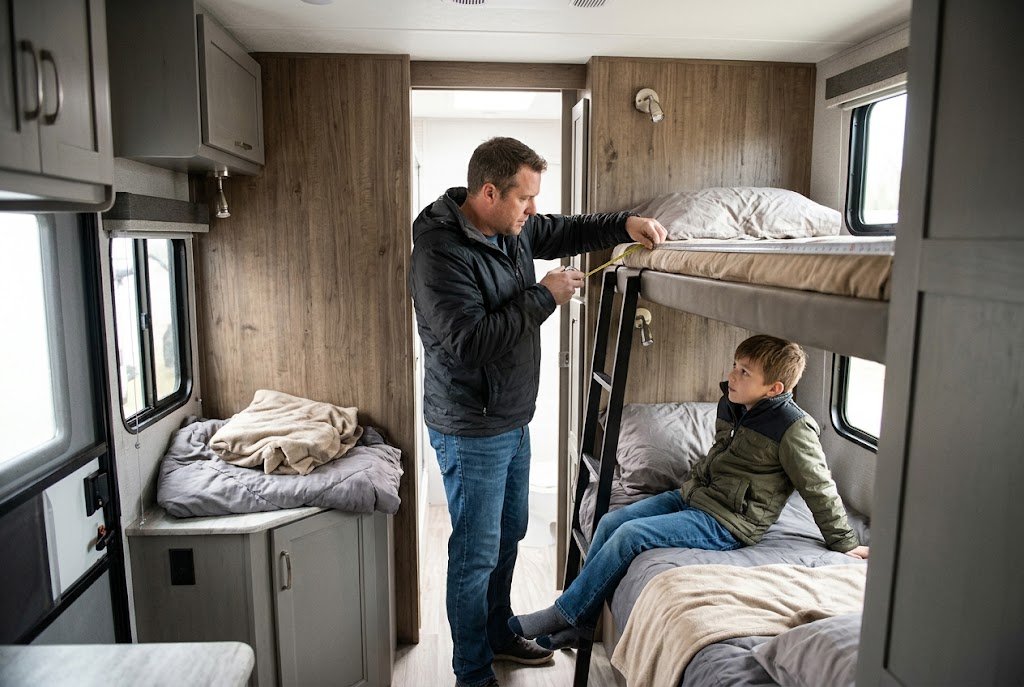
Check the bunks in person, because spec sheets rarely list mattress size or head room. A short visit can save you from a trailer your kids outgrow in a season.
Before you commit, go through this list:
Mattress length and width, compared with your children’s current height
Clearance above each bunk, especially the upper one
A ladder or easy way up, and a guardrail or barrier where needed
The manufacturer’s weight limit for each bunk, especially if teenagers will use them
Window and vent placement, since bunk rooms can get warm
Outlets and lighting near the bunks
A door or curtain for privacy
Storage for shoes, jackets, and toys
Ask where the second bathroom trip would go, too. A rear bath next to the bunks can be convenient, but think about how noise carries.
What Mistakes Do Families Make With Bunkhouse Trailers?
The most common mistake is choosing a bunkhouse by its sleeping capacity instead of by how the beds are actually arranged. Other errors tend to show up after the first season.
Counting convertibles as daily beds. The dinette is rarely a good nightly bed.
Ignoring bunk dimensions. Kids grow, and a bunk that fits a seven-year-old may not fit a twelve-year-old.
Buying near the tow limit. Loaded weight is higher than dry weight, so leave a buffer.
Skipping the walkthrough on a used unit. Used inventory can be listed as-is, so check the roof, floors, tires, and appliances yourself.
Forgetting storage. Outdoor pass-through space and pantry size affect daily life more than a long feature list.
If you are unsure, consider renting first. Camp-A-Rama lists travel trailer rentals, which can help you test a layout before you buy.
How Can Camp-A-Rama Help You Choose a Bunkhouse Travel Trailer?
Camp-A-Rama is an RV dealership at 481 US Highway 68 W in Benton, KY, serving families from Mayfield, Murray, Paducah, and Marion, Illinois. You can browse new travel trailers and used travel trailers, compare brands like Prime Time and Keystone, and walk the floorplans in person.
Shoppers looking for an RV dealership near Paducah can start with this local page. There are also pages for Mayfield and Murray.
If you plan to finance, review the financing page. If you have an RV to trade, the trade-in page explains the process. After the sale, the service department and parts counter are available for maintenance and accessories. Showroom hours are Monday through Friday, 8 AM to 5 PM, and Saturday, 10 AM to 3 PM.
Frequently Asked Questions
What is the best size bunkhouse travel trailer for a family?
For most families, a bunkhouse between 30 and 32 feet works well. That range usually fits a front bedroom, a full kitchen, a rear bath, and bunks. Larger families may want more sleeping capacity, but always compare length and weight against your tow vehicle before choosing.
How many kids can sleep in a bunkhouse travel trailer?
Most bunkhouse trailers have two to four bunk spaces, depending on the floorplan. The listed sleeping capacity also counts the dinette and sofa. Count permanent beds first, then treat convertible spots as extra space for guests or occasional overflow.
Are bunkhouse travel trailers heavier than other travel trailers?
Often, yes, because they are longer and have more sleeping and storage space. The units on Camp-A-Rama’s site listed here range from about 6,068 to 6,413 pounds dry. Always compare GVWR, hitch weight, and your vehicle’s rated capacity, not dry weight alone.
Is a used bunkhouse travel trailer a good idea?
It can be, especially for budget-minded families. Inspect the roof, floors, tires, and appliances carefully, and read the listing terms. Some used units are sold as-is, so a thorough walkthrough matters. A dealership can help you compare condition and pricing.
Do bunkhouse trailers have enough storage for a family?
Storage varies by floorplan. Look for a pantry, wardrobe space, and outdoor pass-through storage. The Tracer 275BH, for example, is described by the manufacturer as having a walk-in pantry and pass-thru storage. Check capacity in person and compare it with how much your family packs.
What should I ask a dealer about a bunkhouse floorplan?
Ask for the number of permanent beds, bunk dimensions, bunk weight limits, GVWR, hitch weight, and cargo capacity. Also ask where the bathroom sits relative to the bunks, and whether the unit is new or sold as-is. A walkthrough answers most of the rest.
Final Takeaway
The best bunkhouse travel trailer for your family is the one with enough permanent beds, bunks that fit your kids, and a weight your tow vehicle can handle with room to spare. Start with the floorplan and the bed count, then compare weight and storage. Browse the Camp-A-Rama travel trailer inventory, contact the team, or call (270) 527-1374 to schedule a walkthrough.